

Everyone’s an expert now. Ain’t that so?
Well, at least everyone has an expert sitting in his cellphone.
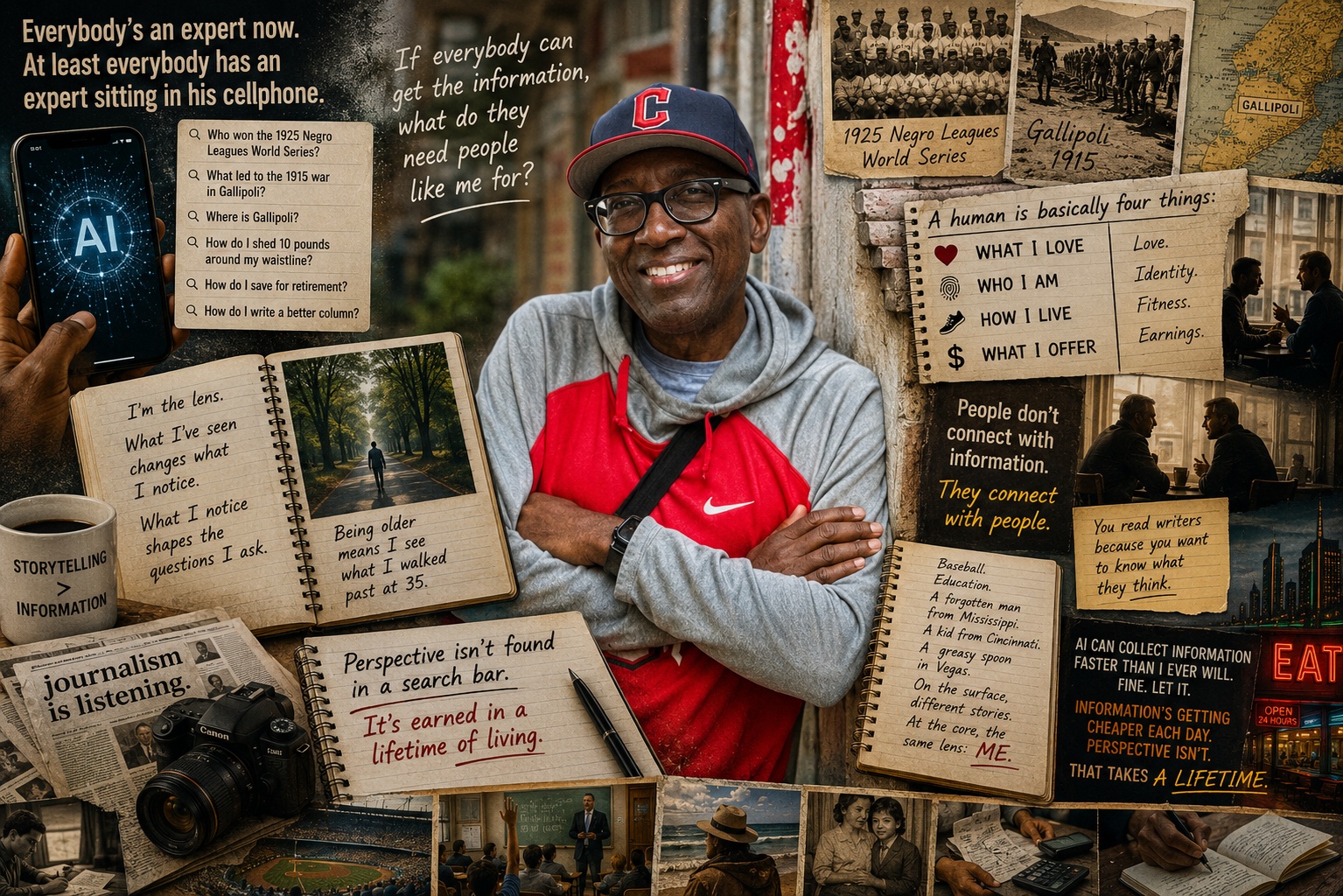
Ask a question. Any question, really. What team won the 1946 Negro Leagues World Series? What led to the 1915 war in Gallipoli? Where’s Gallipoli anyway? How do I shed 10 pounds of blubber around my waistline? How do I save for retirement (OK, I’m already retired; ignore that question)? How do I write a better column (I could use help there, can’t I)?
Turn to artificial intelligence, and in a few seconds, kaboom, there’s my answer.
Which has led me to wonder aloud: If everybody can get the information, what do they need people like me for?
Maybe we’ve been selling the wrong stuff.
On the ’net, I ran across an interesting idea about storytelling. The argument was that a human like me is basically four things: who I am, what I love , how I live and what I offer.
Identity. Love. Fitness. Earnings.
Now, I can’t speak for anybody else, but I’m always suspicious when somebody tries to cram human life into four boxes. I’ve been around too long for that. People are more complicated. Yet the more I thought about it, the more I realized there was something to the larger point.
People don’t connect with information. People connect with people.
Think about the writers you read. You probably aren’t reading them because they possess some secret stash of facts unavailable to others. Google took care of that years ago. AI has pretty much completed the job.
You read those writers because you want to know what they think. There’s a difference.
The late columnist Betty DeRamus never owned the facts about Detroit. Thousands of people knew Detroit as well as she did, maybe better. Yet nobody saw Detroit quite like DeRamus.
That’s what readers came for, which is why I’ve never been crazy about this advice that writers need to “find a niche.”
Pick sports. Pick politics. Pick education. Pick travel. Then stay in your lane.
Says who?
Nobody I know lives that way.
They think about their children while watching a ballgame. They fret about finances while they plan a vacation. Somebody dies and suddenly they start thinking about their own health. Something happens today, and they remember advice their mother gave them 25 years ago that made absolutely no sense then.
Now, it does. That’s life.
And maybe that’s the best storytelling, too.
I can write about baseball this week, higher education next week. I can write about some nearly forgotten Black man from Mississippi, a teenager from Cincinnati or something I noticed while sitting in a greasy spoon in Vegas.
On the surface, those stories might not have much in common.
But each does.
Me.
I don’t mean I have to make myself the star of every story. God knows, people have enough stars already. Journalism taught me that sometimes the best thing I can do is shut up and let somebody else’s story breathe.
Still, I’m the lens.
What I’ve seen determines what I notice. My missteps frame the questions I ask. Being older means I notice things now that I walked past at 40.
AI can collect information faster than I ever will.
Fine.
Let it.
Information gets cheaper each day. Perspective doesn’t.
That takes a lifetime.
