
It’s good to make some noise now and then, but what noise you make ought to be worth people’s time to hear.
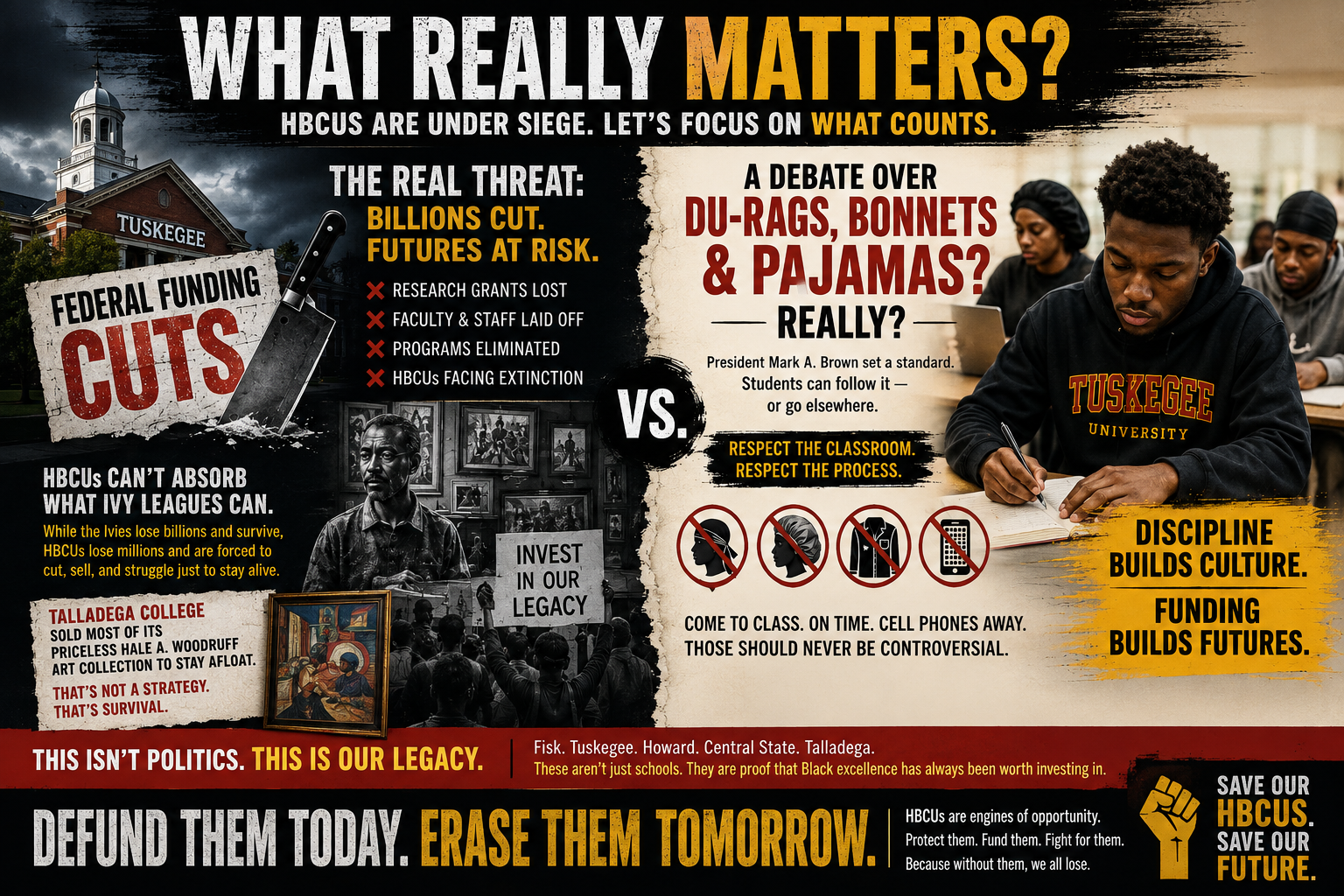
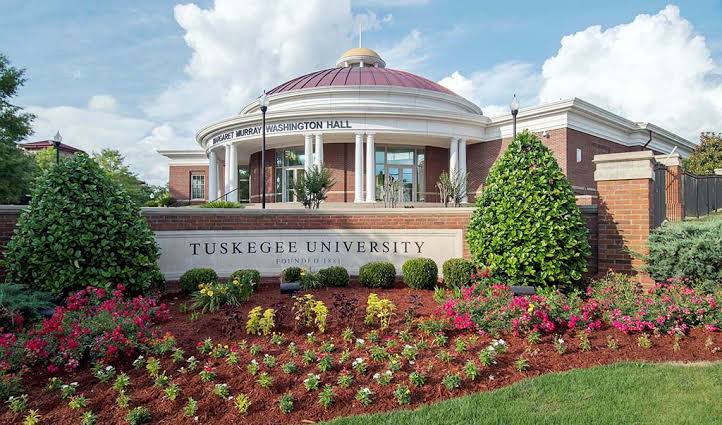
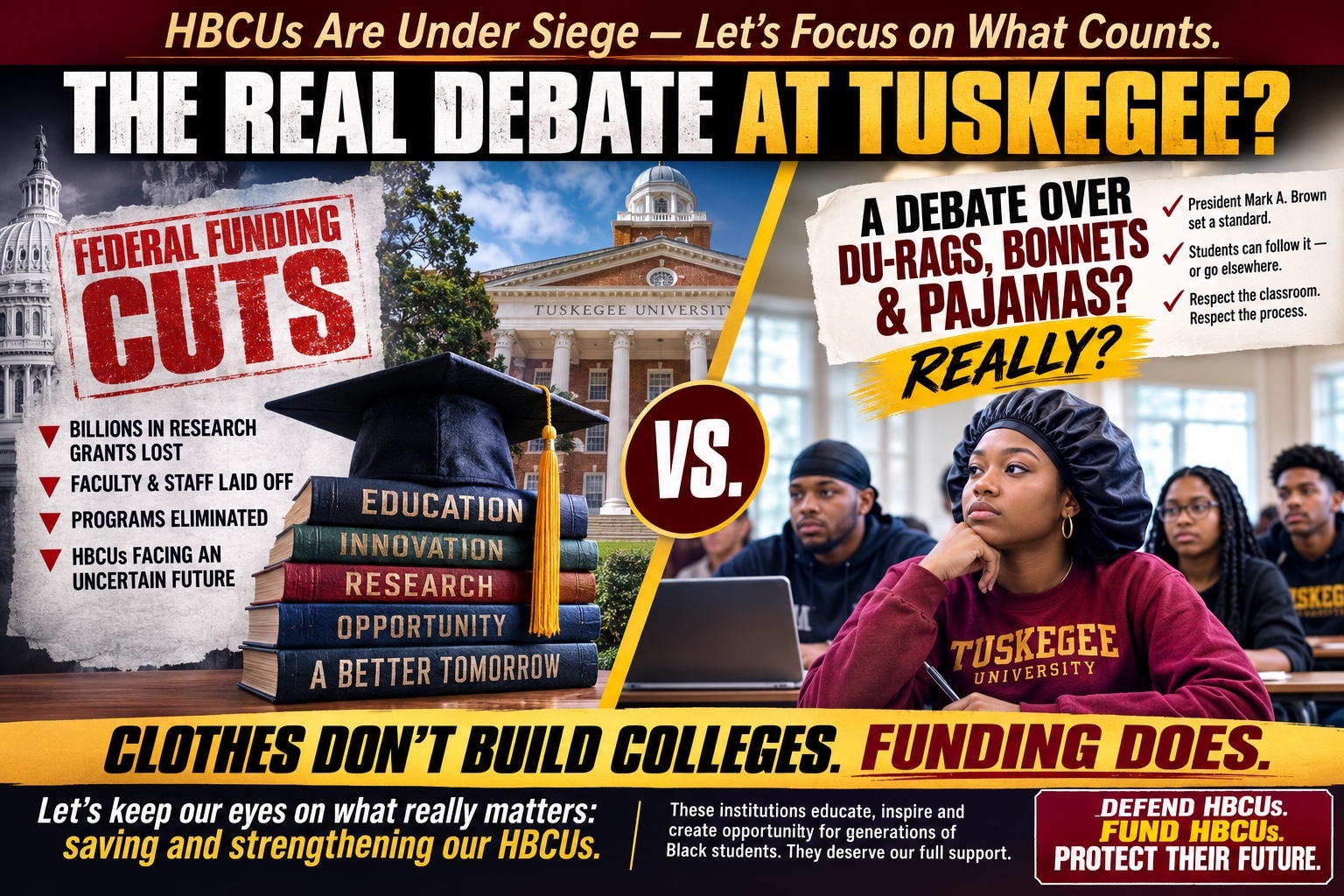
And there has been a lot of the latter about Tuskegee University and its decision to reset policies about a couple of matters, which include how students dress. Tuskegee President Mark A. Brown declared bonnets, du-rags and pajamas inappropriate to wear in classrooms. He also, some would argue, had the audacity to insist students come to class—and come on time. Who would have thought a university president would have to make such a demand?
Well, the answer would be anybody with a front-row seat in higher education. I had one.
So, I suppose I should make a big to-do about Brown’s decision. I won’t. Although I agree with him, does it really matter if a buxom student arrives in my class with a bikini or in Victoria Secret panties? Will clothing affect how she learns?
Clothes don’t make the student, which is why I’m not going to dwell on that subject. But I’m wondering why others are. Brown set a standard, so students should follow the standard or go somewhere else.
I’d rather weigh in on something more germane to the process of learning because I’ve heard mostly silence about it.
No college can thrive without adequate funding, and federal and state governments have taken a meat cleaver to the funding of higher education. I’ve heard schools denounce those cuts, and in response to them, they have let staff and faculty go. They’ve also foregone expansion of programs and eliminated programs altogether.
Under the Trump administration, Ivy Leagues have lost billions in grants to fund research, and most of them, with their hefty endowments, can absorb deep cuts without wholesale destruction of their academic standards.
HBCUs like Tuskegee University can’t. Yet on the eve of the academic year, its alumni, students and their parents are raising cane about clothing. They’ve been loud about it, too.
Go ahead and reject Brown’s edict on dress, his insistence on students coming to class and his demand they put away cellphones, but I don’t think any of it would fill in the funding cuts governments have slapped on Tuskegee, Central State University, Fisk University or on a tiny HBCU like Talladega College in Alabama, which sold most of its priceless collection of Hale A. Woodruff’s artwork to stay afloat.
I’d never heard of Talladega College, but if the federal government was going to take a chunk of money from Howard University, the flagship of HBCUs, Talladega certainly wouldn’t get much, which might lessen its chances to thrive or survive.
Let’s me put it like this: HBCUs are under siege; their futures look dark. Their situation should have all of us focused on how to save these historic institutions and not on what a university president says students can’t wear.
In a broadest sense, HBCUs are struggling. They’re facing an environment in which institutions that educate people of color have fallen into disfavor. Just shutter Fisk and send Black students to larger universities like the University of Tennessee or Tennessee State, which is an HBCU. Pretend Fisk never existed, right?
Some might say the same of Tuskegee, its history be damned. But if a conservative dress code is all we can fuss about, HBCUs like it are doomed.
